GUS STEELMANThirty Years of Kept Receipts
Launch promo ends in 00:00:00
Get the Calendar — $47 $27
Gus Steelman · Tools, Prices, and When To Buy

Nobody tells you the drill was sixty dollars last week.

I watched a man pay ninety for it because the sign came down on a Tuesday. Thirty years of buying tools with my own money taught me the part nobody says out loud: when you buy matters more than how hard you hunt, and the price tag is telling you something if you know how to read it. Twelve months, four stores, in order.

Instant download · Yours forever
12Months · One Chapter Each
4Stores · Told Straight
136Pages · First Edition
Gus Steelman in his workshop
Gus Steelman · Thirty years, and the receipts to prove it

“I have paid full price in June for a thing that went to half in November. We have all done it. Once is education. Twice is a book.”

— The dedication
I · The Book

A shopping book. Not a how-to.

This will not teach you to hang a door. There are better books for that and I own several of them.

What this one does is narrower and, I think, more useful. It tells you when to buy, where to buy, and what the price tag is actually saying at four American stores: Harbor Freight, Home Depot, Lowe's, and Walmart. That is the whole subject. Twelve months, four stores, and the difference between the price you pay and the price the same item wears in a different week.

I should tell you who is talking, because it matters for what you do with the advice. I am not a buyer for any of these companies. I have never worked a day at their corporate offices and nobody there has ever told me anything. I have no inside line and I am not going to pretend I do, because you would find out soon enough and then you would not trust anything else in the book.

What I have is thirty years of buying tools with my own money and the bad habit of keeping the receipts. I ran a small remodeling outfit for most of that time. I bought the cheap tool and regretted it. I bought the expensive tool and regretted that too.

“Nobody tells you. The information exists — it is scattered across ten thousand forum posts and a thousand videos and the memory of anybody who has been paying attention for a long time. Nobody has sat down and put a year of it in order. So here is a year of it, in order.”

I will also tell you where the advice is soft. Two things in this book were reliable for a decade and are wobbling right now, and when we get to them I say so plainly instead of selling you the version that sounds better. That includes the famous one — the yellow tag code every video on the internet repeats. Part of it still works. Part of it is coming apart. The chapter tells you which is which, and what to read when the code fails you.

You will notice there is no number on the cover telling you this book saves you four hundred dollars a year. I could have put one there. Every book in this category has one. But I do not know your house, your projects, or how much you already own. Here is what I will say instead: if you buy one power tool a year and this book moves that purchase into the right month, it has paid for itself several times over. If you buy more than one, the arithmetic gets better fast.


II · The Difference

The way most of us buy tools — and the way the calendar buys them.

How it usually goes
  • You buy the tool the weekend the project starts, at whatever it costs that day
  • The sign says SALE, so you assume the price is low
  • You learned the tag code from a thirty-second video and have never been told which half of it stopped working
  • You pick a cordless battery platform in about forty seconds, in the aisle, based on what is discounted
  • Open box, floor model, reconditioned all sound like the same kind of bargain
  • You try to save money by hunting harder — more stores, more scrolling, more Saturdays
  • You have no idea what you paid for the same thing two years ago
With the calendar in your pocket
  • You know which month each category is actually discounted, and you put the purchase there
  • You check the sign against your own price book, which beats every sale sign ever printed
  • You know what still holds in 2026, what is wearing out, and what to read on the tag instead
  • You treat the first cordless purchase as what it is: the decision that shapes several thousand dollars over ten years
  • You know which of the three is reliably a bargain — and it is not all three
  • You know when to stop optimizing and just buy the thing today, because attention costs money too
  • Item, store, date, price. Thirty seconds a purchase, and after four months you have a personal price book
III · What's Inside

Four parts, 136 pages, and a rhythm of ten minutes a month.

The book is not meant to be read front to back. Read Part One tonight, read Part Two straight through, then pick it up twelve times a year.

Part One

The Head Start

Half an hour tonight, one Saturday this week, and you are already buying differently.

  1. The Saturday That Pays For This Book
  2. The Four Stores, Told Straight
  3. Five Mistakes That Cost Me The Most
Part Two

How The Price Is Set

The machinery behind the tag. This is the spine of the book — every month chapter leans on it.

  1. Reading The Yellow Tag In 2026
  2. The House-Brand Ladder
  3. Coupons, Ads, And The Price Match
  4. The Return Desk And The Warranty
  5. The Battery Question
  6. Open Box, Floor Model, Reconditioned
  7. What A Tool Actually Costs
Part Three

The Twelve Months

One chapter per month, same shape each time: what the stores are doing and why, what is genuinely worth buying, what is being made to look like a deal and is not, and an honest note on where that month's advice is soft.

  • January
  • February
  • March
  • April
  • May
  • June
  • July
  • August
  • September
  • October
  • November
  • December
Part Four

The Three Lists

The shortest part and the one that will annoy the most people.

  1. The Buy-It-Today List — where waiting costs more than it saves
  2. The Never-At-Full-Price List
  3. The Walk-Past List — regardless of what they cost

And the working pages at the back

  • The Purchase Ledger — item, store, date, price
  • The Twelve-Month Planner — what you want, before you need it
  • The Four-Store Cheat Sheet — one page, take it with you
  • A Closing Note
  • About Gus Steelman
  • Index
Instant download · Yours forever
IV · Reader Results

What readers are saying.

★★★★★

“I read the battery chapter the night before I was going to buy a drill, and I bought a different one. First time in my life I made that decision with a reason instead of a coupon.”

Ray D.Ohio
★★★★★

“The part about the tag code wearing out is the first honest thing I have read on the subject. Everybody else is still selling the version from 2015.”

Marilyn K.Retired, North Carolina
★★★★★

“Started the ledger in the back like he says. Four months in and I have caught two 'sales' that were not sales. My wife has stopped teasing me about the notebook.”

Danny W.Texas
V · About

Who is talking.

Gus Steelman
Gus Steelman

Gus Steelman ran a small remodeling business for most of thirty years and has been buying tools with his own money for all of them. He is not a buyer, a rep, or an employee of any retailer, and he has never worked in the tool industry on the selling side.

What he has is a long habit of keeping receipts and an unusually detailed memory for what things used to cost. No retailer or manufacturer has any relationship with this book. Nobody has been paid for a mention, and nobody has sent him a tool.

“You will notice I am hardest on the stores I shop at most. That is not a contradiction. You only learn where a store is weak by spending a lot of money there.”

He writes about tools, shopping, and the ordinary economics of keeping a house.

Gus SteelmanThe Secret Tool Deal Calendar · First Edition · MMXXVI
VI · The Offer

A year of it, in order.

First Edition · MMXXVI

The Secret Tool Deal Calendar

365 Days of Hidden Bargains at Harbor Freight, Home Depot, Lowe's & Walmart

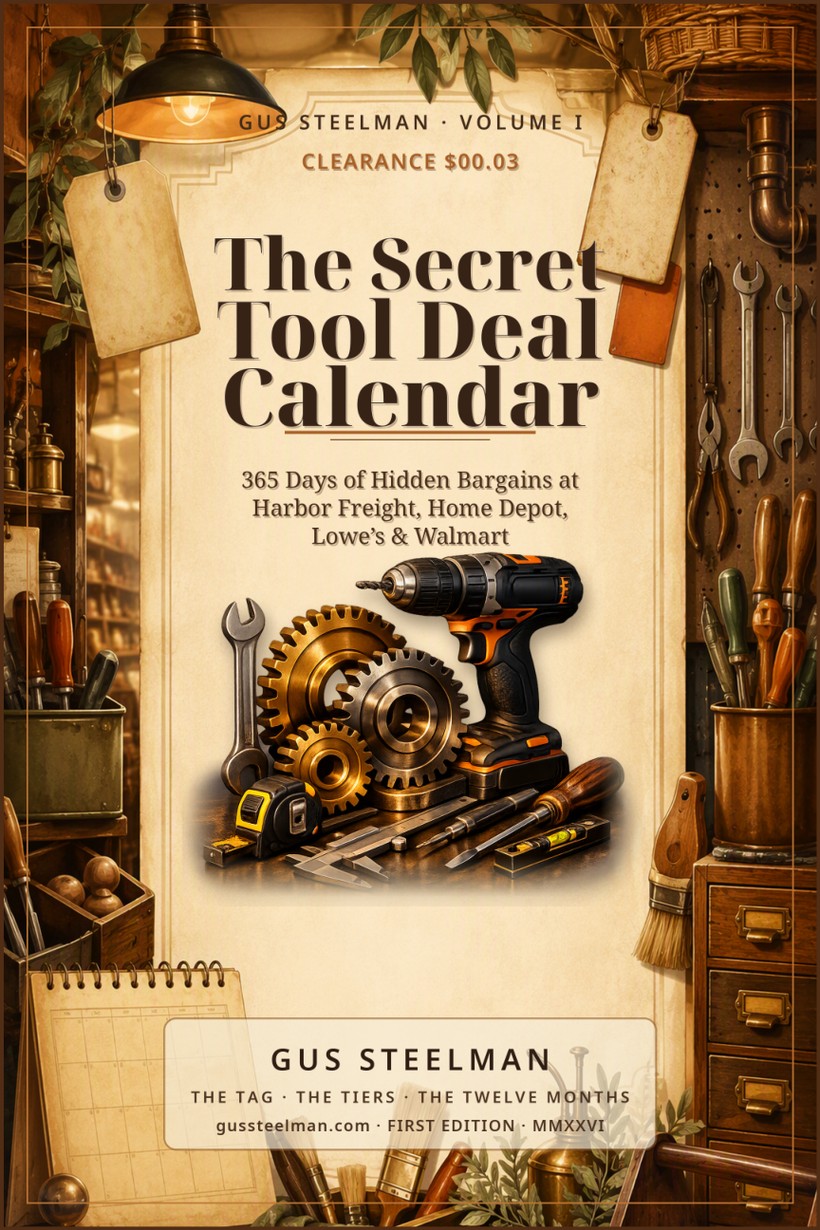
The Secret Tool Deal Calendar — cover
  • The Secret Tool Deal Calendar — the complete 136-page First Edition, delivered as a PDF
  • Part One · The Head Start — three chapters to read tonight, before you go anywhere
  • Part Two · How The Price Is Set — seven chapters on tags, house brands, coupons, returns, batteries, open box, and true cost
  • Part Three · The Twelve Months — one chapter per month, with an honest scope note on each
  • Part Four · The Three Lists — buy today, never at full price, walk past
  • The working pages — Purchase Ledger, Twelve-Month Planner, and the Four-Store Cheat Sheet
  • Read it anywhere — phone, tablet, computer, or print the pages you want in the truck
$47 $27 Launch price
Get the Calendar — $47 $27
Instant download · Yours forever
VisaMastercardAmexPayPalSecure checkout via Gumroad
VII · Questions

Fair questions, answered straight.

Is this insider information from the stores?

No, and I would not trust a book that said it was. I am not a buyer for any of these companies, I have never worked at their corporate offices, and nobody there has ever told me anything. What is in here is thirty years of buying tools with my own money and keeping the receipts. Every pattern in the book cost me something to learn.

Your videos are free — why buy the book?

A video gives you one pattern at a time, in whatever order the algorithm hands it to you. The book gives you the year in order, plus the parts nobody puts in a video because they do not make good thirty seconds: which half of the tag code still works, what the return desk is actually worth, and where each month's advice goes soft.

Does the yellow tag code still work?

Partly, and that is the honest answer. The system is real — it fell out of how the markdown software worked and shoppers reverse-engineered it standing in aisles for years. But it is wearing out. Chapter four tells you which endings still mean what people say they mean, which ones have stopped, and what to read on the tag when the code fails you.

Will these prices be right at my store?

The prices, no. The patterns, mostly. Every dollar figure in the book is a 2026 range, not a quote, because the same tool is genuinely priced differently in Ohio and in the Bay Area. Treat the numbers as a shape — knowing a thing is a forty-dollar item and not a hundred-dollar item tells you what to do when you see it at seventy. Prices and policies vary by location and change without notice; check with the store.

Why only $27?

Because it is a PDF and there is no printing, no shipping, and no warehouse to pay for. $47 is what a book like this normally goes out at, and the launch price is $27 while the first edition is new. If it moves one power-tool purchase into the right month, you are ahead of it.

What format is it, and how do I get it?

A PDF, 136 pages, delivered the moment you order. Read it on a phone, a tablet, or a computer, or print the pages you want to keep in the truck — the ledger and the cheat sheet are laid out for exactly that. Yours forever, and it does not expire.

Do I need to be handy for this to be worth anything?

No. This is a book about buying, not about building. If you own a house and you occasionally need a tool, the calendar works for you the same as it works for somebody with a full shop. If anything it matters more, because the person who buys two tools a year is the one most likely to buy them both in a hurry.

Gus Steelman
Wait — one thing

Less than one tool bought in the wrong month.

That is the whole pitch. $27 for the year in order — twelve months, four stores, and the parts of the tag code that still work. If it moves one purchase into the right week, you are already ahead of it.

Get the Calendar — $47 $27 or see what's inside →